
Written for ‘A’ & ‘IB’ level Economics.

Get the latest case studies delivered fresh to your inbox.
Join 1,196 other subscribers
- The Ongoing Evolution of Singapore’s Household Consumption. (Part 1)CPI is a metric students are familiar with in Macroeconomics. But aside from tracking inflation, it offers us invaluable information about our consumption patterns across time. And that is fascinating stuff to look closely at.
- Drawing The Deadweight Loss For Import Tariff And Quota Diagrams.
 The deadweight loss associated with import tariffs and quotas is a very important concept in International Trade for Economics students, since it enhances the justification for free trade.
 - Responses To The Problem Of Asymmetric Information
 Asymmetric Information is an example-heavy topic in Micro Economics that students frequently struggle with. Read about two simple examples that my students use to great effect here.
 - How To Diagram A Direct Tax and Subsidy
 Direct Taxes and Subsidies have a history of springing nasty surprises at students, who make the mistake of presuming that these are only footnotes in school materials and “will never appear in exams”.
 - How To Explain The Price Mechanism Using Signals And Incentives.
 “How do I explain the signaling and incentivisation functions of the price mechanism in the exam?” Many students have asked me about that, and this is my response.
 - Why Is The AD-AS LRAS Vertical?
 The vertical LRAS underpins the classical AD-AS model and it is extremely important for students to understand its formulation. Read the complete explanation for it here!
 - How Governments Contract For Goods & Services.
 We continue on the matter of government provisioning, with the contracting method. The strengths and weaknesses of this method are not well-discussed in many textbooks, and worth a deep-dive here.
 - How Governments Directly Provision Goods & Services.
 Direct provisioning is the default suggestion by most students in dealing with merit and public goods. Few could however write arguments for it, let alone convince themselves.
 - A Cheat Sheet For: The Circular Flow Of Income
 The Circular Flow of Income is a concept that students frequently ignore, to ever-increasing risk. Find out why this shouldn’t be the case and how you can avoid being the exam’s victim.
 - The Cognitive Bias Concept In “A” Level H2 Economics Exam (9570).
 The “A” level H2 Ecnomics syllabus has been revamped significantly for 2023. The explicit addition of Cognitive Bias to the concepts is one that students should pay particular attention to.
 - What Non-Rejectability in a Public Good Means (H2 Economics 9570).
 2023 saw the first introduction of non-rejectability as a characteristic of a public good. Worried about the scant details in your school’s notes, learn the key details here.
 - Weaknesses Of The N-Firm Concentration Ratio: Why The HHI Is A Better Indicator.
 The n-firm concentration ratio as taught to “A-level” and IB Economics students is known to have serious weaknesses. A better alternative is the HHI, which is discussed in detail here.
 - Why Total Revenue Is Maximised When Demand Is Unitary Price Elastic.
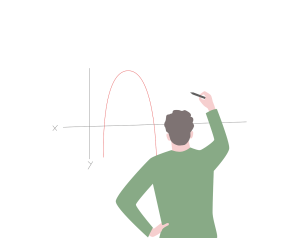 This is a concept commonly tested in “IB” Economics Paper 3. Avoid getting tripped up as a student by learning these simple proofs in this article.
 - Is A Persistent Current Account Surplus Always Bad?
 Is a persistent current account surplus a boon or a bane? Consequences of economic policy choices are seldom neat, and this is no exception.
 - The HDB Housing Grant As An Example of A Direct Subsidy.
 We haven’t seen much academic materials for direct subsidies in “A” & “IB” level Economics. What better way to talk about it than to wade into Singapore’s current hot topic about housing affordability?
 - I Caught Up With Kelvin, The Economics Tutor.
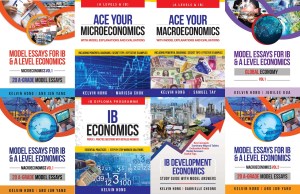 You have probably seen his books when you shopped around for supplementary materials for “IB” and “A” level Economics. See what else he has to say outside the classroom.
 - Can Cutting Interest Rate Reduce Inflation Rate? The Turkish Experience.
 My students will know better than to agree with this statement in the exams. Yet, real-life economic decisions sometimes deviate from academic norms, as in the curious case of Turkey.
 - Where is the Deadweight Loss for a Price Floor?
 Deadweight Loss continues to rankle students wherever it goes. This article is part of an ongoing series that derives it in great detail for various scenarios. Here we discuss about the case of price floors.
 - When Textbooks Can Be Wrong!
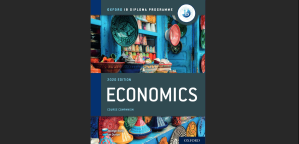 Using Oxford IB Diploma Programme: IB Economics Course Book (2020), by Jocelyn Blink and Ian Dorton, as your IB Economics coursebook? Here’s a serious error in the book that I would like to share about.
 - Price Determination in a Market with Asymmetric Information.
 Most students know how asymmetric information afflicts markets. But few discuss in-depth about price determination in such markets. This piece aims to do more justice to that intriguing topic.
 - Is Singapore’s GST a Regressive Tax?
 If the answer was that straightforward, I wouldn’t have bothered with dedicating an entire article to it.
 - Proof of Diminishing Returns in a Concaved PPC.
 Every student recognises the traditionally-drawn concaved PPC, but many do not fully grasp the significance of the choice in shape.
 - All About GDP and GNI Discrepancies
 Is it always true that the GDP must equal the GNI at the global level?
 - Wage-Price Spiral and Singapore (Part 2 – The Solutions?)
 Direct responses to the fear of the Wage-Price Spiral? Or merely part of side-effects of broader economic wisdom? We explore the solutions to the problem from the previous article here.
 - Wage-Price Spiral and Singapore (Part 1 – Is It That Scary?)
 Don’t underestimate the Wage-Price Spiral as a major consideration in considering how big a scourge Inflation can be. Singapore’s MAS had something to say about it.
 JC Econs 101